

Agile/SAFe & DevOps
I have been doing Agile delivery for nearly a decade and a half. Agile is the concise delivery of software solutions, moving us away from "Big Bang" Waterfall development. Many people misunderstand Agile. Agile delivery is the execution of a set of use cases within a Sprint cycle (i.e., 2-4 weeks). However, Agile does not necessarily include requirements and design. You could spend months on requirements and design without any systems integration (e.g., app dev).
DevSecOps (AKA DevOps) is where Development meets Operations with Security built all around the Software Development Life Cycle (SDLC). Invented in 2008, it builds off of Lean and Agile philosophies to continuously develop applications (i.e., Continuous Integration / Continuous Delivery (CI/CD). DevOps includes many parts of other methodologies including Rapid Application Development (RAD), Extreme Programming (XP), feature-based development, Human-centered Design (HCD) etc.
01
Lean/ITIL (80s) <> Agile (2001) <> DevSecOps (2008)
The evolution of Lean to Agile (SAFe was added along the way) to DevSecOps has been remarkable. Lean, championed by Japan's Toyota Production System, was developed to streamline process steps, lower error rates, reduce waste and keep employees as efficient in the manufacturing process as possible.
The Just-in-time (JIT) inventory process, as well as Autonomous Automation (AKA Automation) and Kaisen (e.g., quality refinement), ensured an efficient production line system for vehicle development.
Next, Agile was developed in 2001 as an evolution of Lean. Needless to say, Agile has revolutionized app development. I have helped develop numerous applications using variations of Agile methodologies. SAFe is large development effort with 50-125 FTEs across teams used to execute Agile Release Trains (ARTs). Simply put, SAFe is Agile on fire with many teams coming together for large-scale implementations.
DevSecOps came next in 2008, building on the concepts of Lean and Agile. DevSecOps brings development, operations and security together as one cohesive team. Everyone should learn DevSecOps. Start by reading the "DevOps Handbook" and the "Phoenix Project."
02
Agile Development
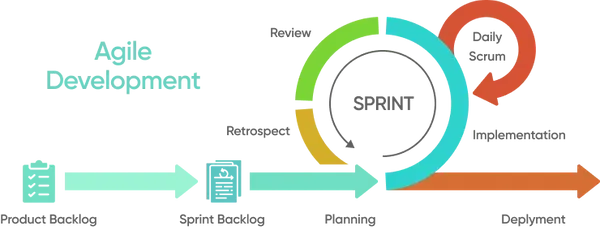
As mentioned above, Agile development is often misunderstood. You start with project planning and then move to requirements gathering before moving to design. The Product Backlog below includes all of the use cases derived from feature-set development (e.g., Epics).
Once you have a robust Product Backlog, you move your first set of use cases into the Sprint Backlog. You are now ready to run a Sprint, which could last anywhere from 1 week to 4 weeks but should ideally be 2 weeks. This is your Sprint that includes planning, development/implementation, review, retrospective and, finally, your deployment to PROD. The features are now live.
The daily scrums are 15-minute daily check-ins for the team led by a scrum master. I have hardly seen 15-minute check-ins work properly. It almost always takes at least 30 minutes. Agile means staying "nimble" in the process.
For junior folks, learning the concepts of Agile is critical. Get your PMP certification. There are key roles within Agile teams (5-11 FTEs) - e.g., Scrum Master to leads team, Product Owner to own the product backlog, Product Manager to own the product, developers, analysts, SMEs etc.
03
DevOps for Product
DevOps moves everything closer to the client (e.g., development, testing, QA/QC, operations, security). Therefore, application development becomes everyone's responsibility. For that reason, the "product" is developed with one vision. We move everything (i.e., shift left) including development, testing, staging, production and security.
Keep the architecture loose, make the batch of work small, create a continuous flow of app dev work, seek continuous feedback, fail fast & early and allow everyone to continously learn & experiment. Most importantly, keep delivering applicatoin features (CI/CD). You can deploy code to PROD many times a day.
04
Application Development using DevOps Best Practices
Until someone comes up with a better way to develop applications within the SDLC, DevOps is here to stay. I have been studying DevOps for past few years and I understand is from both a conceptual POV and in practice.
DevOps is a major add to Agile, and includes many unique roles (e.g., -Product Owners - Developers - DevOps Engineers - UI/UX - QA/QC - Operations - InfoSec Engineers - Release Managers - Value Stream Managers - Site Reliability Engineers (SREs) etc). These roles become evermore essential in a DevOps environment.
Agile/SAFe + DevOps = success!
03
Agile complements DevOps

04
Move to Cloud
Applications developed using DevOps concepts are developed for the Cloud. While I am not an expert in any specific clouds (e.g., Amazon Web Services (AWS), Google Cloud Platform (GCP) and Microsoft Azure), I understand how applications are developed for the Cloud.
Whether it's a public cloud, private cloud, multi-cloud or hybrid cloud, DevOps is used to develop applications for the Cloud.
As each year passes, we have fewer on-premise data centers and everything is moving to the Cloud. Therefore, it is even more essential to build applications using DevSecOps, as security is paramount to long-term sustainability of these applications.
